


He was doing everything right.
And nothing was changing.
Six professionals were supporting him. Each had a coherent explanation and a reasonable plan. He followed them all, one after another. Here is what no one had looked at.
“I don’t understand what is happening to me. In training, everything works. In competition, I’m no longer myself.” The starting point
Everything pointed to a mental problem.
During competition week, he became rigid. He missed decisions he made instinctively in training. Everyone concluded it was mental. No one listed what his body was saying at the same time.
Six professionals. Six defensible diagnoses.
A concentration problem
Errors appeared precisely when the situation demanded greater awareness and adaptability.
A training load problem
Perceived fatigue increased while training volume remained comparable.
An adherence problem
The nutrition plan looked sound on paper but became difficult to maintain through the realities of the season.
Tension and compensation patterns
The body accumulated mechanical signals, with no single injury explaining the overall picture.
Poorly managed pressure
Attempts to reassure, motivate or correct sometimes added even more information to process.
A character flaw
Every drop in performance became personal evidence: “I’m no longer resilient enough.”
What prevents his system from staying clear-headed, stable and adaptable as demands increase?
Each of the six answers addressed a symptom. None asked why the system was producing six at once. He was not fragile: he arrived at competition with his reserves already depleted.
Eight dimensions to make sense of the system.
Each dimension was filled with what already existed: assessments, calendars, training data and the athlete’s own account. What mattered emerged between the boxes, not inside them.
Biology & functional health
Symptom timeline, available assessments, medication, infections, travel, stress and signals requiring medical referral.
Load & recovery
Calendar, travel, sleep, HRV, RPE, fatigue and actual capacity to adapt to the existing training volume.
Energy availability
Intake, carbohydrates, protein, hydration, timing and post-exercise recovery in real life, not just on an ideal plan.
Microbiota & digestive context
Symptoms, diversity, fermentation potential, medication history, tolerances and consistency with the overall context.
Nervous system & decisions
Decision quality under fatigue, time pressure, noise, the effect of a previous error and incomplete recovery.
Identity & pressure
Need for control, fear of disappointing others, self-worth tied to reliability and perceived safety under demanding conditions.
Movement & pain
Recurring discomfort reconsidered alongside load, sleep, available energy, nervous system activation and capacity to adapt.
Environment & logistics
Meals, transfers, phone use, staff communication, family pressure and unnecessary decisions around competition.
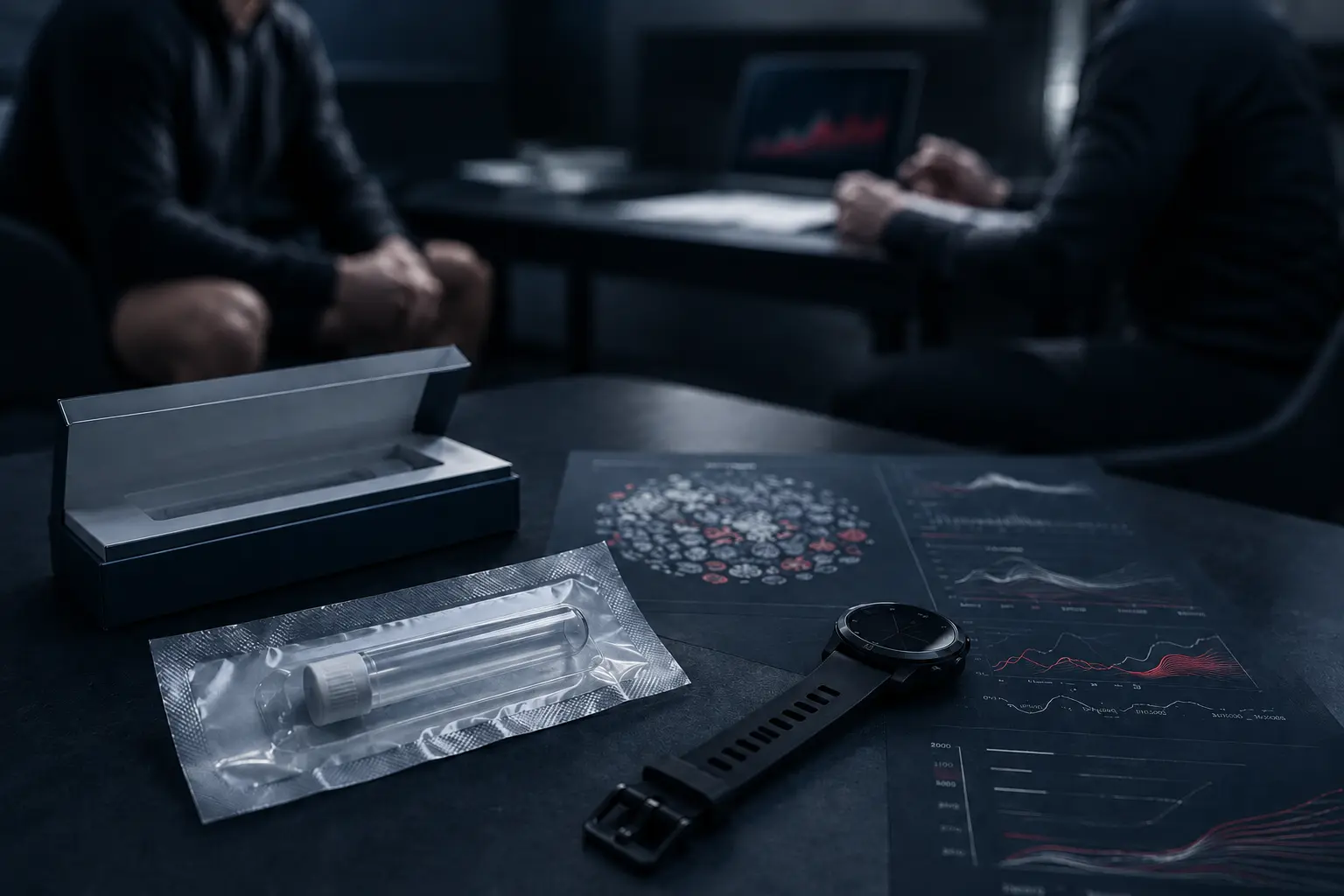
A clue. Not a verdict.
The test alone tells us nothing. It was assessed alongside symptoms, actual food intake, medication, sleep, training loads and stress.
The microbiota was not the cause. The discovery was that the athlete was eating and taking supplements as though his biological baseline were already stable.
Reduce the biological and cognitive cost of performance.
No extra training, no extra motivation, no new stack of supplements. First, give him room to adapt again.
- Protect health and rule out warning signs.
- Stabilise energy and recovery.
- Make digestion more predictable.
- Rebuild food tolerance and dietary diversity.
- Reduce decision overload.
- Realign the athlete, staff and environment.
- Build confidence through repeated experience.
Seven phases. One guiding principle.
Every action had to reduce noise, increase safety and make the athlete’s response under load more predictable.
Safety & baseline
Before optimising, rule out clinical warning signs requiring a doctor and establish a usable baseline.
- Sleep and HRV
- Internal and external load
- Energy and mood
- Digestive symptoms
- Actual food intake
- Decisions in competition
Microbiota in context
Look for vulnerability in the ecosystem, consistency between data and symptoms, then the most sustainable ways to act. The test remains one data point, never a standalone diagnosis.
Performance nutrition
Start again with adequate energy intake, fuelling around exercise, hydration, gradual fibre increases and controlled food reintroductions.
Recovery & rhythm
Protect the 72 hours around competition: post-exercise meals, decompression, morning light, sleep and reduced cognitive load.
Clarity under changing conditions
Practise technique under controlled fatigue, time pressure, noise, after an error and at the end of sessions. Measure decision quality, not just execution.
Identity & control
Replace “I have to be strong” with “I recognise what is happening and choose the next useful action.” The pressure remains, but it no longer automatically becomes a threat.
Staff & environment
Less emotionally charged feedback, more observable criteria, logistics prepared in advance and one priority indicator per week. The environment stops consuming the reserves regained.
Alongside the existing staff, not in their place.
PERFORMA’s role is to bring coherence to the information, clarify the priority and refer to the appropriate professional whenever necessary.
Nothing spectacular. Changes we could measure.
Responses vary according to the person, sport, season and clinical situation. No individual outcome can be guaranteed.
More predictable digestion and less bloating on critical days.
More stable energy and better tolerance of the nutrition strategy.
More regular sleep and a greater sense of recovery.
Less compulsive control over routines and bodily sensations.
Fewer errors towards the end of exertion and greater consistency between training and competition.
Clearer communication with staff and less recurring discomfort.
What we look at, and when.
Every decision left a record.
- Before-and-after performance data
- Load, recovery, HRV and sleep
- Digestive symptom diary
- Anonymised medical assessments
- Microbiota analyses where relevant
- Staff feedback shared with permission
- Analysis of decisions under pressure
- Continuity across the competition calendar

Talent does not disappear. Sometimes it remains trapped in a system that has become too costly to sustain.
What if, in your case too, no one was looking at the same picture?
That is what a first conversation is for: rebuilding an understanding of your situation and identifying what deserves attention first. If there is nothing to add, we will tell you.
An exploratory first conversation · No standardised promises · Medical referral when needed